Craft · 22 July 2026 · 9 min
Provenance on paper.
The chain is a notary. The print is a test of whether the colour was ever real.
By the democratpeak desk
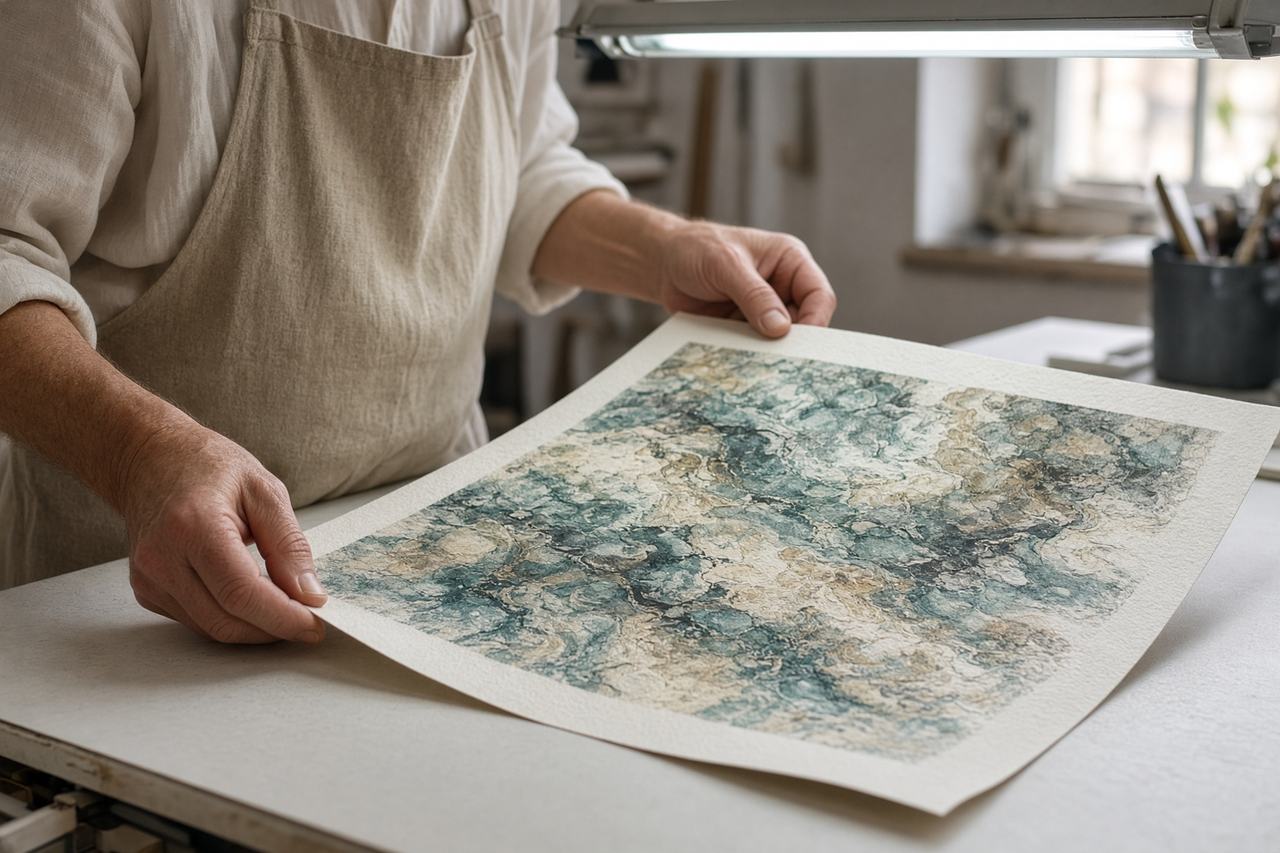
A surprising number of the on-chain artists we take seriously still end the week in a print studio. Not because they have failed to be digital, but because paper is ruthless. A file can flatter. A pigment print of the same image, pulled on a decent stock under a daylight lamp, will tell you whether the colour was a decision or a default.
Editioning is the old craft of saying how many, and why that many. The chain can do the counting. It cannot do the looking. What we see, in studios from London to the North, is a paired object: a token that records the edition, and a print that has to survive a wall. Sometimes the print is unique. Sometimes it is one of twelve. Sometimes there is no print, only a note that there never will be, which is also a decision.
If it cannot hold on paper, be suspicious of how it holds on a screen.
Certificates have become a small literature of their own: QR codes, contract addresses written in pencil, embossed chops, a sentence about what happens if the marketplace dies. The good ones are boring. They say where the file lives, who may display it, and what the collector is actually holding. The bad ones mimic a share certificate and hope you will not ask.
Mio Han, whose small sculptures only complete themselves when a token exists, still photographs every object on a sheet of paper before it leaves the bench. “If I cannot describe it without the metadata,” she told us, “it is not finished.” That is not anti-chain. It is adult.
For collectors, the practical advice is simple. If you are offered a print, look at the print. If you are offered only a token, ask how you will live with it. If you are offered both, ask whether they are one work or two. Then keep the paper. Paper, unlike a front-end, does not need a password reset.