Essay · 28 August 2026 · 11 min
London after the rush.
The tourists left. A handful of rooms simply continued the work they were already doing.
By Sian Calder · London / Milnthorpe
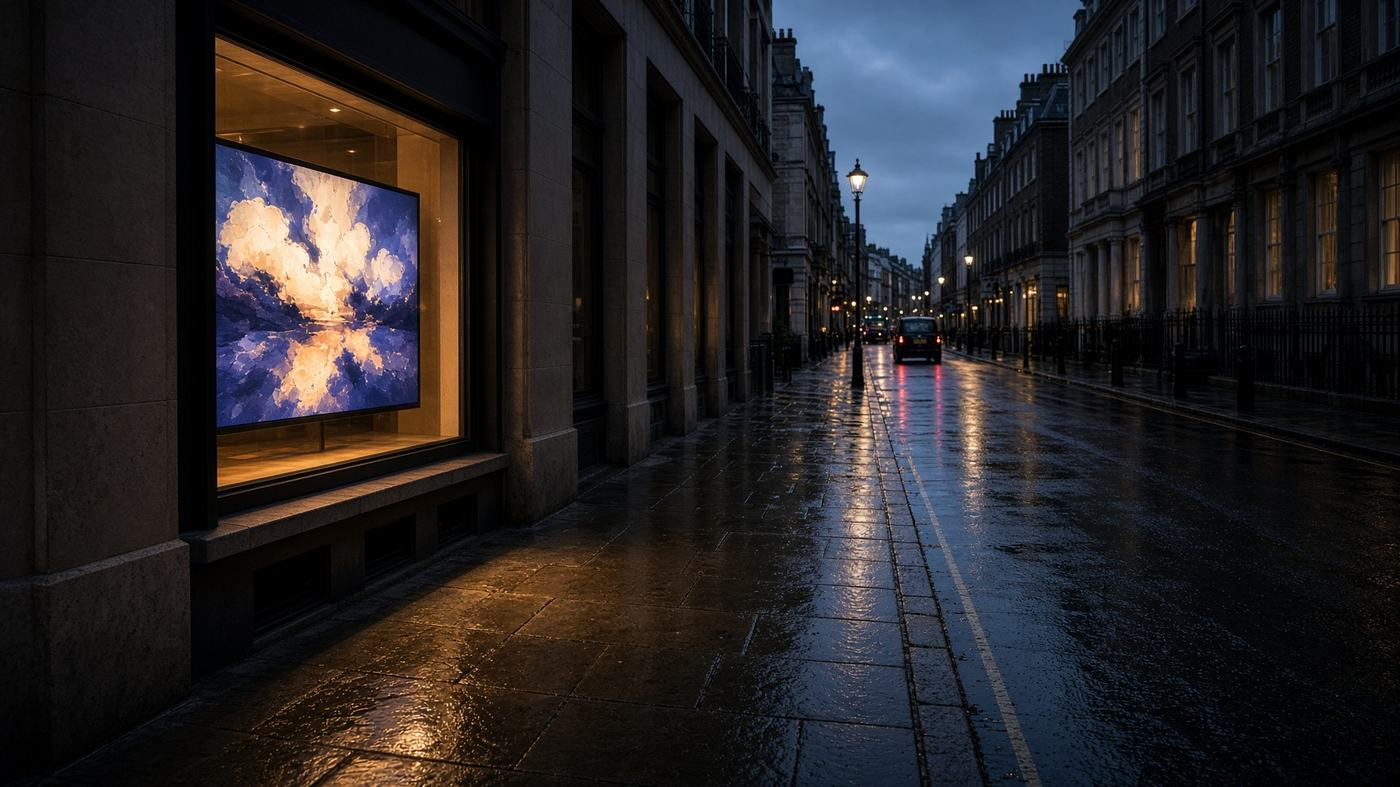
Walk a Mayfair side street after rain and you can still catch a digital work in a vitrine, washing colour onto the pavement. It looks like the boom never ended. It did. What you are seeing is a hangover with good lighting: a few dealers who learned the vocabulary, a few collectors who kept the wallet, a city that is very good at absorbing a fashion and displaying the remains under glass.
The more interesting London is slightly further out, and slightly slower. arebyte has spent a decade treating software, networks and game engines as materials rather than as marketing. Furtherfield, in the park, has kept a civic argument running — art as infrastructure, not as drop. Serpentine’s Arts Technologies strand never needed a profile-picture season to justify putting artists in a room with people who write protocols. The Photographers’ Gallery has, quietly, been one of the better places to think about the image once the image became a file. Somerset House continues to behave as if digital work belongs in a courtyard with a queue, which is a compliment.
A boom is a weather system. Institutions are drainage.
During the peak years the city acquired pop-up “NFT galleries” with the lifespan of a pastry. Some of them showed serious work by accident. Most of them showed liquidity with a frame. When the floor fell in, the pop-ups left. The older rooms looked, from certain angles, as if they had been waiting for the noise to stop so they could hear themselves think.
Two Londons
There is a London of viewing rooms: wood, grey fabric, a screen at the far end, the hush of people who might bid. There is a London of warehouses: brick, a projector, a cold draught, someone you do not know standing too close to a beam of light. Both are real. Neither is the whole story. The mistake, in 2021, was to let the first London speak for the second.
Auction houses did what auction houses do. They tested whether a new object class could be sold to people who already buy objects. Sometimes the work was substantial. Sometimes the catalogue note did more labour than the file. That is not a moral failing unique to digital art; it is the ordinary weather of a market. What was new was the speed, and the way online rooms let spectators confuse attention with collecting.
If you are in the city this season, skip the language of “web3” on the door. Go where the work is installed, not where it is announced. Stay for the loop. If a piece cannot survive ten minutes in a room, it will not survive ten years in a collection. London still has rooms. Use them.